Saturday, October 23, 2010

Hilda Solis: June Cleaver, meet Juana Solis

Official portrait of Secretary of Labor Hilda ...Image via WikipediaHilda Solis: June Cleaver, meet Juana Solis | News for Dallas, Texas | Dallas Morning News | Opinion: Viewpoints: "Now policymakers, employers and workers must find better ways to help people succeed at home and on the job. Products need to be made and parent-teacher conferences need to be attended. Aging parents need to be cared for and work deadlines must be met. Children get sick and have to stay home from school on the same day the big presentation is due at work. Yes, women now comprise nearly 50 percent of American workers, and in the majority of U.S. families, women are co-equal or even primary earners.
But this isn't just a women's issue. Men today have nearly doubled the amount of time they spend on child care, according to recent studies. Nearly half of all children in the U.S. live in households where all parents work full time. More than 43 million Americans serve as unpaid caregivers to family members over the age of 50. We are all in this together.
Work-life balance policies and workplace flexibility initiatives aren't niceties; they're necessities for working families. For employers, they aren't just the right thing to do; they're the smart thing to do. A recent report by the President's Council of Economic Advisers found that when businesses adopt accommodating policies, it adds to the bottom line.

Read the article here.
Enhanced by Zemanta

Tuesday, October 19, 2010

How to Raise Powerful Women

Geeta Desai is president of the AAUW Poughkeepsie Branch. Her October message in their newsletter is reprinted here with Geeta's permission.
2 year-old girl.Image via Wikipedia
Thirty-three years ago, I looked down on my new-born daughter’s face and silently vowed to raise her to be a powerful woman. At the time, little did I know that I had embarked on an arduous but enlightening journey. There were all the usual challenges: boys to ward off, homework to be done on time, telephone calls to be limited to daylight hours, arguments to be had about whether a curfew was even necessary.

My biggest challenge, however, was to model the strength that I wanted her to develop. For example, I did not want her to be crushed when girlfriends let her down or to let criticism cut her to the quick, or to turn to counterproductive habits when she was stressed. But, in reviewing my own behavior in the early years I realized that I, on the other hand, had been guilty of all of these lapses; I had been inconsolable when I didn’t get my first “big “job, I had reached for excessive amounts of chocolate when I’d been blue, I had let criticism wound me repeatedly. To develop the resilience, strength and optimism that I wanted my daughter to have, I knew that I had to change the habits of a lifetime.

Looking back, I recognize the two things that would have helped me immensely. First, I wish I had joined the AAUW a long time ago. The company of smart, strong, supportive women would have helped me to develop an inner strength and a balanced perspective. Second, I wish my daughter could have taken advantage of girl-friendly events like our very own “Live YourDream” conference for seventh graders.

Still, I’m happy to say that my daughter has turned out to be a force to contend with. I talk to her about the AAUW, the great women I’ve met, our wonderful projects and the anxiety I feel about how much work still remains to be done. She talks to me about working in the male-dominated film–editing business, her dreams and her fears. We’re still muddling through that long journey that we started so many years ago but it is now filled with brilliant insights, touching moments and much more faith in ourselves.

For those of you who may be raising a seventh grade girl or know someone who is, please visit our website at www.aauwpoughkeepsie.org and please encourage as many girls as you can to attend the “Live Your Dream” Girls’ Conference.

This year’s conference on Saturday, November 6 will cover friendships, creative self-expression, girl power, writing and publishing articles, dealing with diversity in schools, fashion and self-respect. If you would simply like to volunteer at this event, come at 1 pm to help sign out the girls.

So, here’s to strong girls and stronger women. May our ranks continue to grow.
Geeta Desai
If you know a 7th grade girl in the Hudson Valley who could benefit from attending (and who wouldn't benefit?), please share the conference information with them.
Enhanced by Zemanta

10/19/10: GASLAND at UUCC Kingston

If you haven't seen GASLAND yet,
get thee to the UUCC tonight! --

7 PM on Tuesday, October 19
Unitarian Universalist Congregation of the Catskills
320 Sawkill Road
Kingston, NY

Sponsored by the Social Action Committee of UUCC
as part of its Issues Of Our Times series. Free admission.
For more information, call Paula at 845-679-2821.

Friday, October 15, 2010

Water, water everywhere....

Today is Blog Action Day 2010. The topic is water.

Thinking Globally
Almost a billion people on the planet live without access to safe drinking water. You can help change that. Click on the petition link on the right to support the UN's efforts to bring clean, safe water to millions. For $25, you can give clean water to one person for a lifetime. Or you can start our own fundraising campaign. Click here for more information.

Acting Locally
1. Come to our next branch public policy meeting on Tuesday, 10/26 at the Kingston Library, 55 Franklin Street. We'll meet in the 2nd Floor Craft Room (to the right of the Children's Library) and watch Blue Gold: World Water Wars (2008, 90 min.) at about 5:45 PM, then discuss it. This film is based on the book Blue Gold: The Fight to Stop the Corporate Theft of the World's Water by Maude Barlow and Tony Clarke.

"Wars of the future will be fought over water, as they are today over oil, as the source of all life enters the global marketplace and political arena. Corporate giants, private investors, and corrupt governments vie for control of our dwindling fresh water supply, prompting protests, lawsuits, and revolutions from citizens fighting for the right to survive. Past civilizations have collapsed from poor water management. Will ours too?"

Also recommended (we might watch at a later date): Flow (2007, 84 min.) "A look at the world's water crisis and how the causes of the depleting water supply is connected to pollution, human rights, and even politics."

Optional homework assignment:
Read the Blue Gold book and share your thoughts during the post-film discussion

2. Just say no to fracking!

a.
Watch GASLAND.

b.
Submit written comments on NYS DEC's Draft Strategic Plan for State Forest Management by 10/29. Let's ask DEC to remove the entire Mineral Resources section (pages 225 to 242) from this document, and ask that our state forests never be leased to the gas industry. From page 231: "A significant amount of concern with hydraulic fracturing has been expressed both within and outside DEC due to the high volume of water used (up to eight million gallons per well)."

c.
Support our neighbors in PA. Here's one way: attend the post-Election Day Rally to Stop Shale Gas Drilling on Wed., 11/3 in Pittsburgh. At noon, rallygoers will march across the Rachel Carson bridge to protest at the Developing Unconventional Gas (DUG) East conference. Check out the Water Management Workshop description: "Water use and disposal in the Marcellus shale is a huge issue of importance to operators, local citizens and regulators. From 2005 to 2009, the Pennsylvania Department of Environmental Protection issued more than 2,000 permits for new Marcellus wells—and the average frac can use 3- to 5 million gallons of water. Some 10% to 30% of that returns to the surface, to be treated or recycled."

d.
Get informed at:
http://dontfrackwithny.com/
http://frackaction.com/

3. Get to know our greatest local body of water: the Hudson River (shown above). Go for a walk in a riverside park, dip your toes in, take a swim, go fish, indulge in a fall cruise, go sailing or kayaking, visit a lighthouse. Get involved with and/or donate to Clearwater, Riverkeeper, or another group of your choice.


The real bottom line: Love your mother. She is made up of 70% water, like our brains! Let's use them wisely, and do whatever it takes to protect mother earth's precious water and all of her natural resources — for all living beings, for we are all connected.

Tuesday, October 5, 2010

Now showing: GASLAND at Upstate Films

If you haven't seen GASLAND yet, here's your chance! It's showing this week - Tues (10/5), Wed. (10/6), and Thurs. (10/7) at 5:45 PM and 8 PM - at Upstate Films in Rhinebeck, NY.

Thursday, September 23, 2010

9/23/10: Public hearing on NYS DEC's State Forest Management Plan


Public hearing tonight (9/23):
6:30 to 9:30 PM
DEC Region 3 Headquarters
Main Conference Room
21 South Putt Corners Road
New Paltz

Thursday, September 2, 2010

Workplace Salaries: At Last, Women on Top

Workplace Salaries: At Last, Women on Top

Have you read about this study, yet? Women earning more than men in some urban markets. The headline is a bit misleading, but the news is unexpected, until you read the details. Here are some excerpts from the Time article:

Here's the slightly deflating caveat: this reverse gender gap, as it's known, applies only to unmarried, childless women under 30 who live in cities. The rest of working women — even those of the same age, but who are married or don't live in a major metropolitan area — are still on the less scenic side of the wage divide. ...
He [the researcher, James Chung] attributes the earnings reversal overwhelmingly to one factor: education. For every two guys who graduate from college or get a higher degree, three women do. This is almost the exact opposite of the graduation ratio that existed when the baby boomers entered college. Studies have consistently shown that a college degree pays off in much higher wages over a lifetime, and even in many cases for entry-level positions. ...

... he found that the cities where women earned more than men had at least one of three characteristics. Some, like New York City or Los Angeles, had primary local industries that were knowledge-based. Others were manufacturing towns whose industries had shrunk, especially smaller ones like Erie, Pa., or Terre Haute, Ind. Still others, like Miami or Monroe, La., had a majority minority population. (Hispanic and black women are twice as likely to graduate from college as their male peers....
Significantly, the conditions that are feeding the rise in female wages — a growing knowledge-based economy, the decline of a manufacturing base and an increasing minority population — are dominant trends throughout the U.S. "This generation [of women] has adapted to the fundamental restructuring of the American economy better than their older predecessors or male peers," says Chung. While the economic advantage of women sometimes evaporates as they age and have families, Chung believes that women now may have enough leverage that their financial gains may not be completely erased as they get older....
The holdout cities — those where the earnings of single, college-educated young women still lag men's — tended to be built around industries that are heavily male-dominated, such as software development or military-technology contracting. In other words, Silicon Valley could also be called Gender Gap Gully.


Read more: http://www.time.com/time/business/article/0,8599,2015274,00.html#ixzz0yP632vwi

Wednesday, September 1, 2010

AAUW Kingston Branch Officers: 2010-11

Congratulations to our new 2010-2011 AAUW Kingston Branch Officers and many thanks to those of you who completed your terms

2010 -2011 Officers
President
- Bette Nitzky
VP, Programming - Beverly Sloane

VP Membership - Ruth Bean
Treasurer - Jane Riley
Recording Secretary - Carole Leib
Corresponding Secretary - Joan Reis
Committees
Bus Trips - Vivi Hlavsa
Communications - Ruth Wahtera
Directory - Sheila Beall
Diversity - Arlene Bruck
Educational Foundation - Doris Goldberg & Gloria Sender
Historian - Virginia Kohli
Hospitality - Pat Stedge and Ginger Yaples
International - Rokki Carr
Legal Advocacy Fund - Dolores LaChance
Publicity - Rosalie Zimmerman
Public Policy - Susan Holland
Telephone Tree - Dot Henry

See your directory for phone numbers and email addresses. We'll be adding links as we complete more profiles.
Enhanced by Zemanta

Monday, August 30, 2010

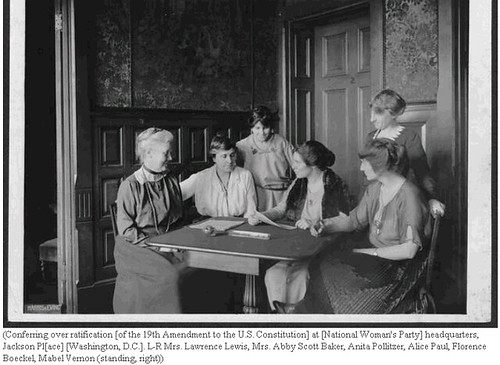
Women weren't given the right to vote; we fought for it


Ninety years have flown by since the passage of the 19th Amendment.

What do you think those fearless women and men who fought for women's right to vote would think if you told them they could only get paid 77 cents for every dollar a man earns for comparable work? [According to new data from the Bureau of Labor Statistics, the gap between men's and women's median earnings widened slightly between 2007 and 2008, from 78 percent to 77 percent for full-time, year-round workers.]

What do you think they would think of the small number of women in House and Senate?

Wouldn't they think there might be a connection?  Here's how these two issues are intertwined:

Women get paid less because there's no place to turn for protection under the law. The House has already  passed the Paycheck Fairness Act. More than once. If the Senate hasn't passed it before they adjourn in a few weeks, we start over again at the beginning. Again.

Here in NY, our elected representatives have played games with pay equity legislation, as they have with so many other issues. So, we don't have protection at the state level, either. I think Susan B. Anthony is right.
“There never will be complete equality until women themselves help to make laws and elect lawmakers.” -- Susan B. Anthony

 While many men say they support equal pay, they don't seem to be in office. Or, they aren't exerting their influence to get this legislation passed. And, nationally, the number of women in office may actually drop.

An article today by Lisa Mascaro in the LA Times said: 
Women now hold 90 [of 435] seats in Congress: 69 are Democrats and 21 are Republicans. After the November election, Congress could end up with as many as 10 fewer female members, prognosticators now say, the first backslide in the uninterrupted [slow] march of women to Washington since 1978.
So, here are a few things you can do:
  • Take Action: Ask our representatives what specific things they will do now to ensure that pay equity legislation is passed now
  • Ask every candidate this fall for their position on pay equity and whether they will provide leadership for passing pay equity and comparable worth legislation.
  • Reach out to friends and family in other states, especially those with senators uncommitted or opposed to the Equal Pay Act, asking them to take action. You can find Congressional voting records on "women's issues" .here.
  • Think about the women you know who would make strong candidates for office now or in the future. Encourage them to think about running. There are lots of resources available to help women sort out what it takes and whether to run. You can find a few here.
  • Subscribe to the Two-minute Activist to stay abreast of these issues.