Wednesday, March 24, 2010

Celebrating Mary Seacole on Ada Lovelace Day

Rokki Carr sent this profile of Mary Seacole from the Spartacus Educational site in the UK:

A portrait of Mary Seacole in oils c. 1869, by the obscure London artist Albert Charles Challen (1847–81). The original was discovered in 2003 by historian Helen Rappaport, and acquired by the National Portrait Gallery in London in 2008.

Mary Jane Seacole (1805-1881)
Dedicated Healer and Entrepreneur

Mary Seacole was born in Kingston, Jamaica in 1805. Her father was a Scottish army officer and her mother a free black woman who ran a boarding house in Kingston. Mary's mother also treated people who become ill. She was a great believer in the herbal medicines. These medicines were based on the knowledge of slaves brought from Africa. This knowledge was passed on to Mary and later she also become a 'doctress'.

In 1850 Kingston was hit by a cholera epidemic. Mary Seacole, using herbal medicines, played an important role in dealing with this disease. She also dealt successfully with a yellow fever outbreak in Jamaica. Her fame as a medical practitioner grew and she was soon carrying out operations on people suffering from knife and gunshot wounds.

Mary loved travelling and as a young woman visited the Bahamas, Haiti and Cuba. In these countries she collected details of how people used local plants and herbs to treat the sick. On one trip to Panama she helped treat people during another cholera epidemic. Mary carried out an autopsy on one victim and was therefore able to learn even more about the way the disease attacked the body.

In 1853 Russia invaded Turkey. Britain and France, concerned about the growing power of Russia, went to Turkey's aid. This conflict became known as the Crimean War.

Soon after British soldiers arrived in Turkey, they began going down with cholera and malaria. Within a few weeks an estimated 8,000 men were suffering from these two diseases. At the time, disease was a far greater threat to soldiers than was the enemy. In the Crimean War, of the 21,000 soldiers who died, only 3,000 died from injuries received in battle.

When Mary Seacole heard about the cholera epidemic she traveled to London to offer her services to the British Army. There was considerable prejudice against women's involvement in medicine and her offer was rejected. When The Times publicized the fact that a large number of British soldiers were dying of cholera there was a public outcry, and the government was forced to change its mind. Florence Nightingale, who had little practical experience of cholera, was chosen to take a team of thirty-nine nurses to treat the sick soldiers.

Although Mary Seacole was an expert at dealing with cholera, her application to join Florence Nightingale's team was rejected. Mary, who had become a successful business woman in Jamaica, decided to travel to the Crimea at her own expense. She visited Florence Nightingale at her hospital at Scutari but once again Mary's offer of help was refused.

Unwilling to accept defeat, Mary started up a business called the British Hotel, a few miles from the battlefront. Here she sold food and drink to the British soldiers. With the money she earned from her business Mary was able to finance the medical treatment she gave to the soldiers.
Whereas Florence Nightingale and her nurses were based in a hospital several miles from the front, Mary Seacole treated her patients on the battlefield. On several occasions she was found treating wounded soldiers from both sides while the battle was still going on.

After the war ended in 1856 Mary Seacole returned to England. She hoped to work as a nurse in India but she was unable to raise the necessary funds. Mary Seacole died in London on May 14,1881.

For more information about Mary Seacole see Wikipedia or The Victorian Web
Reblog this post [with Zemanta]

Celebrating Rachel Carson on Ada Lovelace Day

Rachel Louise Carson (1907-1964)

Rachel Carson — writer, scientist, and ecologist — grew up in the rural river town of Springdale, PA. She graduated from Pennsylvania College for Women (now Chatham College) in 1929, studied at the Woods Hole Marine Biological Lab, and received her MA in zoology from Johns Hopkins in 1932.

During the Depression, the U.S. Bureau of Fisheries hired Carson to write radio scripts. She supplemented her income by writing feature articles on natural history for the Baltimore Sun.

In 1936, she began a 15-year career in the federal service as a scientist and editor and rose to become Editor-in-Chief of all publications for the U. S. Fish and Wildlife Service. Carson wrote pamphlets on conservation and natural resources and edited scientific articles.

In her free time, Carson turned her government research into lyric prose, first as an article "Undersea" (1937, for the Atlantic Monthly), and then in a book, Under the Sea-Wind (1941). In 1952, she published her prize-winning study of the ocean, The Sea Around Us, which was followed by The Edge of the Sea in 1955. Carson resigned from government service in 1952 to devote herself to her writing.

Carson wrote several other articles designed to teach people about the wonder and beauty of the living world, including "Help Your Child to Wonder," (1956) and "Our Ever-Changing Shore" (1957). Embedded within all of her writing was the view that human beings were one part of nature distinguished primarily by their power to alter it, in some cases irreversibly.

Disturbed by the profligate use of synthetic chemical pesticides after World War II, Carson reluctantly changed her focus in order to warn the public about the long term effects of misusing pesticides. In Silent Spring (1962), she challenged the practices of agricultural scientists and the government, and called for a change in the way humankind viewed the natural world.

Carson was attacked by the chemical industry and some in government as an alarmist, but courageously spoke out to remind us that we are a vulnerable part of the natural world subject to the same damage as the rest of the ecosystem. Testifying before Congress in 1963, Carson called for new policies to protect human health and the environment.

Rachel Carson died in 1964 after a long battle against breast cancer. Her witness for the beauty and integrity of life continues to inspire new generations to protect the living world and all of its creatures.

Source: http://www.rachelcarson.org/

© Linda Lear, 1998, author of Rachel Carson: Witness for Nature (1997).

Photo of Carson from Lear/Carson Collection, Connecticut College.

To find out about Ada Lovelace Day, go to: http://findingada.com/

Celebrating Ellen Swallow Richards on Ada Lovelace Day

Women in Chemistry: Ellen Swallow Richards: "Ellen Swallow Richards

If you're confident that your tap water is safe to drink and your groceries are safe to eat, your confidence rests on the work of Ellen Swallow Richards.

In 1887 Richards conducted an enormous, pioneering survey of drinking water in Massachusetts, which led to the establishment of water-quality standards and modern sewage treatment plants. Richards then pursued chemical studies to determine the ingredients in groceries, along with their quality, which eventually led to state food and drug standards.

Richards was the first woman to attend the Massachusetts Institute of Technology (MIT), where she spent her entire career. She founded a women's chemistry laboratory at MIT and established the field of 'home economics,' which used science to improve sanitation in people's homes."

Today is Ada Lovelace Day -- the international day of blogging to celebrate the achievements of women in technology and science.

Initially I considered posting about Ellen Richards because she and Marion Talbot founded the organization that became AAUW and during her career she faced so many of the challenges women still face today.

She initially worked at MIT for no pay, never mind fair pay! And, although she completed work for her PhD, the MIT powers-that-be balked. No PhD for a woman.

She came from a poor family and earned money cleaning to put herself through Vassar, one of the few colleges for women at that time. She couldn't get a job as an industrial chemist, so she convinced MIT to let her enroll. They noted on accepting her that her admission shouldn't be seen as setting a precedent.

Reading about Ellen Richards' career at MIT convinced me. I recently watched the video of Rep. Jackie Speier (D-CA) addressing the AAUW National Convention on the Ten Commandments for Women Overcoming Obstacles. One of the stories she tells is how two MIT faculty members collected and presented data to the MIT administration proving that MIT was shortchanging women on lab space, research money, and positions on decision-making committees (the committees with the power). MIT listened, changed its policies, and put their money where their policies lay. That's a story I want to learn more about.

Want to know more about Ellen Swallow Richards? There are many references to her on the web. I especially liked this one at Women in Chemistry.

Reblog this post [with Zemanta]

Tuesday, March 23, 2010

Help Circulate Our Pay Equity Fact Sheet


Fair Pay Day is coming, April 20,  and our branch goal is to get twenty other local organizations to join us in spreading the word about pay equity. To that end, we've pulled together a fact sheet for members to provide to the organizations where they have connections.


Here's what we need you to do -- easy:
  • Forward the link or pdf of the fact sheet to everyone you know. Ask them to let you know whether their organization did something.
  • Talk about Pay Equity with your friends
  • Write a letter to the editor
The branch is also planning a public event of some sort -- we'll keep you posted.
Reblog this post [with Zemanta]

Tuesday, March 16, 2010

3/16/10: Book group to discuss Autobiography of Miss Jane Pittman

For our March book discussion, we'll meet at 1 PM today (Tuesday, 3/16) in the local history room on the 1st floor of the Kingston Library, 55 Franklin Street, to talk about The Autobiography of Miss Jane Pittman by Ernest J. Gaines. ViVi Hlavsa will present background on the author.

We'll watch the 18-minute video called The Psychological Residuals of Slavery at our next meeting -- on April 20 (Equal Pay Day), when we will be discussing First Mothers by Bonnie Angelo.

Thursday, March 11, 2010

Irena Sendler, The Female Oskar Schindler


Irena Sendler was a Roman Catholic who created a network of rescuers in Poland who smuggled about 2,500 Jewish children out of the Warsaw ghetto in World War II, some of them in coffins.

Mrs. Sendler was head of the children’s bureau of Zegota, an underground organization set up to save Jews after the Nazis invaded Poland on Sept. 1, 1939. Soon after the invasion, approximately 450,000 Jews, about 30 percent of Warsaw’s population, were crammed into a tiny section of the city and barricaded behind seven-foot-high walls.

On April 19, 1943, the Nazis began what they expected would be a rapid liquidation of the ghetto. It took them more than a month to quell the Warsaw ghetto uprising. By then, only about 55,000 Jews were still alive; most of them were sent to death camps.

Also by then, however, Mrs. Sendler’s group of about 30 volunteers, mostly women, had managed to slip hundreds of infants, young children and teenagers to safety.

Irena Sendler, as a non-Jewish social worker, had gone into the Warsaw Ghetto, talked Jewish parents and grandparents out of their children, rightly saying that all were going to die in the Ghetto or in death camps, taking the children past the Nazi guards or using one of the many means of escape from the Ghetto-the old courthouse for example- and then adopting them into the homes of Polish families or hiding them in convents and orphanages. She made lists of the children's real names and put the lists in jars, then buried the jars in a garden, so that someday she could dig up the jars and find the children to tell them of their real identity. The Nazis captured her and she was beaten severely, but the Polish underground bribed a guard to release her, and she entered into hiding.

Irena had made false documents for people in the Warsaw area from 1939 to 1942, helping save many, BEFORE she joined the underground Zegota and started saving children.

In 1965, Mrs. Sendler became one of the first of the so-called righteous gentiles honored by the Yad Vashem Holocaust memorial in Jerusalem. Poland’s Communist leaders did not allow her to travel to Israel; she was presented the award in 1983.

Irena Krzyzanowska was born in Otwock, in what is now Poland, on Feb. 15, 1910. Her father was a physician. Her marriage to Mieczyslaw Sendler ended in divorce after World War II. Her second husband, Stefan Zgrzembski, died before her. She is survived by her daughter, Janka, and a granddaughter.
Irena passed away on May 12, 2008 at the age of 98. She was buried in a Warsaw, Poland cemetery. Her family and many of the rescued children continue to tell her story of courage and valor. The Life in a Jar students continue to share her legacy through the play, the web site, through schools and study guides, and world media.

American filmmaker Mary Skinner began working on a historical documentary film based on Irena Sendler's memoir as told to Anna Mieszkowska in 2003. "Irena Sendler, In the Name of Their Mothers"

Saturday, March 6, 2010

AAUW Branch Meeting Locations During Library Elevator Servicing

The Kingston Library elevator is out of service for the next month or two. We're figuring out the best location for our meetings during this time and will post the information here and on our calendar.


Tuesday, March 23, 6:30 - 7:45 PM
Branch Meeting:
Writing Our Memoirs

1st floor, outside the Local History Room
Note: the library closes at 8 PM and there will be no refreshments at this meeting.

See you there!

Friday, March 5, 2010

Divorced Before Puberty - NYTimes.com

This week Nicholas Kristof wrote an Op-Ed in the NY Times about Nujood Ali, the 10 year old Yemeni girl who won the right to divorce her husband. Her story and the publicity it has garnered has inspired many pre-pubescent girls to seek annulments and divorces. I look forward to reading her book, I Am Nujood, Age 10 and Divorced.

Kristof makes an argument at the end of his column that deserves our attention. He describes Yemen as a "time bomb" and "a hothouse for Al Qaeda." ---dead last in the World Economic Forum's global gender gap index. He goes on to explain why countries that marginalize women often end up unstable.
Op-Ed Columnist - Divorced Before Puberty - NYTimes.com:

"First, those countries usually have very high birth rates, and that means a youth bulge in the population. One of the factors that most correlates to social conflict is the proportion of young men ages 15 to 24.

Second, those countries also tend to practice polygamy and have higher death rates for girls. That means fewer marriageable women — and more frustrated bachelors to be recruited by extremists.

So educating Nujood and giving her a chance to become a lawyer — her dream — isn’t just a matter of fairness. It’s also a way to help tame the entire country.

Consider Bangladesh. After it split off from Pakistan, Bangladesh began to educate girls in a way that Pakistan has never done. The educated women staffed an emerging garment industry and civil society, and those educated women are one reason Bangladesh is today far more stable than Pakistan.

The United States last month announced $150 million in military assistance for Yemen to fight extremists. In contrast, it costs just $50 to send a girl to public school for a year — and little girls like Nujood may prove more effective than missiles at defeating terrorists."
It doesn't take much, but what it takes is so powerful -- education and jobs. When women and minorities have equal opportunity for education and jobs a society stabilizes.
That's both here and abroad.


Reblog this post [with Zemanta]

Wednesday, March 3, 2010

Women's History: Mid-20th Century Female Illustrators

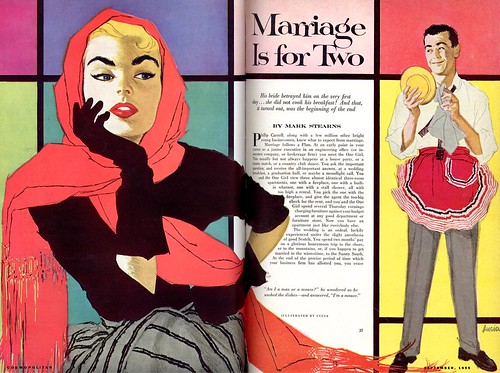
For several years, I've followed Today's Inspiration, a daily post of wonderful '40s and '50s illustrations and lots of information about the artists.   I spend a lot of time at the computer and when I take a break I like to use the other side of my brain. The illustrations fascinate me. They serve as windows into the past as they illustrate stories and sell products.


How appropriate can it be for Women's History Month? -- Leif Peng, the force behind Today's Inspiration, has started a companion blog, Female Illustrators of the Mid-20th Century.
Last week I received, once again, a comment from a reader asking "what about the female illustrators of the mid-20th century?" This is something that comes up again and again, despite my efforts to feature women artists as often as possible. It made me realize that I haven't done enough to get the word out.


Today's Inspiration: Barbara Bradley: A Female Illustrator You Should Know: "Multi-part posts previously presented on TI will be collected and 'reprinted' as single, full-length posts. In this way, I hope FIotM-20C will become a valuable resource for those specifically interested in finding artwork examples and documentation on the careers of female illustrators from the '40s, '50s and '60s."
 So, here's women's history of a different sort -- How the media portrayed women and what it was like to be one of the few women illustrators working during the mid-20th century.

Take a break, relax, enjoy and reflect on both of these great blogs -- or click on over the the full size scans on the flickr sites.


Thanks, Leif!
Reblog this post [with Zemanta]

Monday, March 1, 2010

Women's History Month: Matilda Joslyn Gage

Public relations portrait of Matilda Joslyn Ga...Image via Wikipedia


When all humanity works for humanity, when the life-business of men and women becomes one united partnership in all matters which concern each, when neither sex, race, color, or previous condition is held as a bar to the exercise of human faculties, the world will hold in its hands the promise of a millennium which will work out its own fulfillment.”
- Matilda Joslyn Gage
Meet Matilda Joslyn Gage, the woman the suffragists forgot. In this clip, Dr. Sally Roesch Wagner delivers some of Gage's words in character.


Gage's role in the suffragist movement is worth our attention. The issues she addressed then -- equal rights for women and minorities, separation of church and state, war and peace -- resonate with us still.

Some of us enjoyed hearing Dr. Wagner, Executive Director of the Matilda Joslyn Gage Foundation, tell Gage's story at the Hudson Valley Humanist's this month. Gage is Dr. Wagner's passion.


Reblog this post [with Zemanta]