Showing posts with label Status of Women. Show all posts

Tuesday, March 1, 2011

Women in America: Indicators of Social and Economic Well-Being | The White House

South façade of the White House, the executive...Image via Wikipedia
 Today, kicking off Women's History Month, the White House announced the new report "Women in America." We're looking forward to studying the report and the media coverage it receives, especially given the Republican agenda as it relates to women.
Women in America: Indicators of Social and Economic Well-Being | The White House: "Women in America: Indicators of Social and Economic Well-Being

In support of the Council on Women and Girls, the Office of Management and Budget and the Economics and Statistics Administration within the Department of Commerce worked together to create the Women in America (pdf) report which, for the first time in recent history, pulls together information from across the Federal statistical agencies to compile baseline information on how women are faring in the United States today and how these trends have changed over time. The report provides a statistical portrait showing how women’s lives are changing in five critical areas:"
Enhanced by Zemanta

Tuesday, January 4, 2011

And they wonder why we need laws...Scalia's take on sex discrimination

Supreme Court Justice Antonin Scalia
In December, the Senate refused to allow debate on pay equity legislation. Here's why it's important to pass legislation regarding women's rights. Scalia's comments in a newly published interview in the legal magazine California Lawyer are truly disturbing.

Scalia: Women Don't Have Constitutional Protection Against Discrimination: "You do not need the Constitution to reflect the wishes of the current society. Certainly the Constitution does not require discrimination on the basis of sex. The only issue is whether it prohibits it. It doesn't. Nobody ever thought that that's what it meant. Nobody ever voted for that. If the current society wants to outlaw discrimination by sex, hey we have things called legislatures, and they enact things called laws. You don't need a constitution to keep things up-to-date. All you need is a legislature and a ballot box."

Marcia Greenberger, founder and co-president of the National Women's Law Center, called the justice's comments "shocking."

"In these comments, Justice Scalia says if Congress wants to protect laws that prohibit sex discrimination, that's up to them," she said. "But what if they want to pass laws that discriminate? Then he says that there's nothing the court will do to protect women from government-sanctioned discrimination against them. And that's a pretty shocking position to take in 2011." (My emphasis)

The barriers just got higher and it's time to pass the Equal Rights Ammendment.

Sunday, March 28, 2010

NYS Senator Diane Savino Talks About the Responsibility of being "The First"

As a former Staten Islander, I take a great interest in seeing Staten Island women move into leadership positions. Last fall, Debi Rose became the first African American woman elected to the NYC Council. And, Diane Savino is the first female state senator from the Island. My pleasure grew as I listened to Senator Savino's  comments to the NYS State Senate on Women's History Month. (Just under 3 minutes)


And, if you're unfamiliar with Senator Savino's comments on her vote on the gay marriage bill, do watch the video here. (about 7 minutes)
Reblog this post [with Zemanta]

Tuesday, March 23, 2010

Help Circulate Our Pay Equity Fact Sheet


Fair Pay Day is coming, April 20,  and our branch goal is to get twenty other local organizations to join us in spreading the word about pay equity. To that end, we've pulled together a fact sheet for members to provide to the organizations where they have connections.


Here's what we need you to do -- easy:
  • Forward the link or pdf of the fact sheet to everyone you know. Ask them to let you know whether their organization did something.
  • Talk about Pay Equity with your friends
  • Write a letter to the editor
The branch is also planning a public event of some sort -- we'll keep you posted.
Reblog this post [with Zemanta]

Wednesday, March 3, 2010

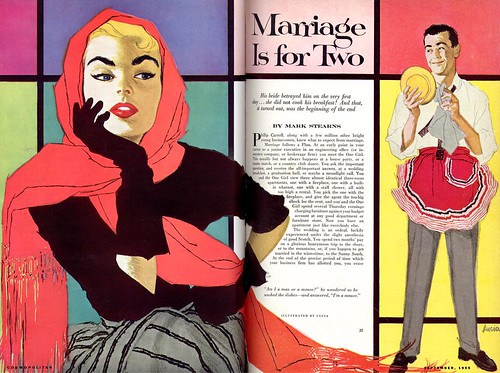
Women's History: Mid-20th Century Female Illustrators

For several years, I've followed Today's Inspiration, a daily post of wonderful '40s and '50s illustrations and lots of information about the artists.   I spend a lot of time at the computer and when I take a break I like to use the other side of my brain. The illustrations fascinate me. They serve as windows into the past as they illustrate stories and sell products.


How appropriate can it be for Women's History Month? -- Leif Peng, the force behind Today's Inspiration, has started a companion blog, Female Illustrators of the Mid-20th Century.
Last week I received, once again, a comment from a reader asking "what about the female illustrators of the mid-20th century?" This is something that comes up again and again, despite my efforts to feature women artists as often as possible. It made me realize that I haven't done enough to get the word out.


Today's Inspiration: Barbara Bradley: A Female Illustrator You Should Know: "Multi-part posts previously presented on TI will be collected and 'reprinted' as single, full-length posts. In this way, I hope FIotM-20C will become a valuable resource for those specifically interested in finding artwork examples and documentation on the careers of female illustrators from the '40s, '50s and '60s."
 So, here's women's history of a different sort -- How the media portrayed women and what it was like to be one of the few women illustrators working during the mid-20th century.

Take a break, relax, enjoy and reflect on both of these great blogs -- or click on over the the full size scans on the flickr sites.


Thanks, Leif!
Reblog this post [with Zemanta]

Saturday, February 27, 2010

Preparing for Equal Pay Day

Later today, a couple of us are meeting to plan for Equal Pay Day on April 20th. In preparing, I came across this little video from The Women's Museum in Dallas, Texas.

What will you be doing this year to raise public awareness of the wage gap? I'll keep you posted on our plans.


Reblog this post [with Zemanta]

Thursday, October 22, 2009

AAUW Member Wins Nobel Prize


AAUW Member Wins Nobel Prize

Carol Greider Shares Prestigious Award for Physiology or Medicine

WASHINGTON, D.C. – AAUW celebrates Carol Greider, AAUW member-at-large and winner of the Nobel Prize in Physiology or Medicine along with her two colleagues, Elizabeth Blackburn and Jack Szostak. Greider has been a member of AAUW since 2002.

Greider, Blackburn, and Szostak “discovered that telomeres are made up of simple, repeating blocks of DNA building blocks and are found in all organisms,” according to a Johns Hopkins University announcement. Understanding this biological process has paved the way to deeper knowledge of cancer and cellular aging.

“AAUW has a long history of supporting women in the sciences, and we are thrilled to count another Nobel Prize winner among our ranks,” said AAUW Executive Director Linda D. Hallman, CAE. In 1920, AAUW awarded two-time Nobel Prize recipient Marie Curie a grant to assist with her groundbreaking research on radium. AAUW member Greg Mortenson, author of Three Cups of Tea, was nominated for the 2009 Nobel Peace Prize for his work supporting education for girls in Pakistan and Afghanistan.

Greider, who holds a doctorate in molecular biology from the University of California, Berkeley, currently works as the Daniel Nathans Professor and Director of Molecular Biology and Genetics at the Johns Hopkins Institute for Basic Biomedical Sciences. She, Blackburn, and Szostak will attend the Nobel Prize awards ceremony in Stockholm, Sweden, on December 10.

“Greider and Blackburn have shown that women can break through barriers in science, technology, engineering, and mathematics,” said AAUW President Carolyn H. Garfein. “Their accomplishment serves as an excellent example of women making valuable contributions and the need that exists for supporting and encouraging great female minds, as AAUW does with our fellowships, grants, and community of successful women.”

In 2009 a record five women were awarded Nobel Prizes. Prior to this year, only 35 women had ever received the honor. Greider and Blackburn were the first two women to simultaneously win the prize in medicine.

The three other 2009 female laureates include Ada Yonath, who is sharing the Nobel Prize in chemistry; Herta Mueller, who won the prize in literature; and Elinor Ostrom, who is sharing the Nobel Memorial Prize in Economic Sciences. Ostrom is the first woman to win the economics prize.

To read what AAUW said on our blog about this year’s Nobel Prize winning women, please visit http://blog-aauw.org/2009/10/12/aauw-member-awarded-nobel-prize/

To view Marie Curie’s page in AAUW’s online museum, please visit https://svc.aauw.org/museum/history/1920_1929/index.cfm


Saturday, October 3, 2009

President Nominates Head of Women's Bureau


This week, President Obama announced Sara Manzano-Diaz as his nominee for director of the Women's Bureau in the Department of Labor.

Manzano-Diaz has served as Deputy Secretary for Regulatory Programs at the Pennsylvania Department of State and as Deputy General Counsel for Civil Rights and Litigation at the U.S. Department of Housing and Urban Development. Latifa Lyles, who recently ran for president of the National Organization of Women, is expected to become the deputy director of the bureau.

For those unfamiliar with the Women's Bureau, it was created by law in 1920 to formulate standards and policies to promote the welfare of wage-earning women, improve their working conditions, increase their efficiency, and advance their opportunities for profitable employment.

AAUW looks forward to working with Ms. Manzano-Diaz and the Women's Bureau to continue to break through barriers for women and girls.
Reblog this post [with Zemanta]

Thursday, September 17, 2009

GRANDMA GOES TO WORK

Modern Social Security card.Image via Wikipedia

We tend to think that gender inequity is an issue for the young. Wrong again.

Job counselors report growth in their "older women" clients category. Who makes up that category?

They're finding women in their 60's, 70's, and even 80's looking for work these days. Here are some of the reasons.

The Institute on Women: GRANDMA GOES TO WORK: "The economic challenges women face as they age are well documented; when compared to similarly aged men:
  • older women workers are less likely to be living with a partner or spouse (62% vs. 80% for men), and are more likely to be on their own when it comes to household resources. (1)
  • older women are less likely to have had continuous employment throughout their adult lives, affecting both their record of work experience and their contribution to Social Security or pension funds. (1)
  • older women are more likely to be working part-time (25% vs. 8% for men), and not necessarily by choice: 16.9% of women age 60-64 report being underemployed, vs. 12.1% of men the same age. (2)
  • older women (age 55 to 59) workers are more likely to have no expectation of retirement benefits (40% of women vs. 27% of men) and are more likely (43% of women vs. 30% of men) to report that they are working because they need the income to pay day to day living expenses. (3)
  • older women employees generally live in households with lower family incomes than their male counterparts ($64,444 vs. $80,839). (1)
  • for older female workers, the wage gap in hourly rates is 69 cents for every dollar earned by a man. (1)"
Hat tip to Christy Jones who posted this link.
Reblog this post [with Zemanta]

Monday, August 24, 2009

A Million Here, A Million There. It starts to add up.

Purse (巾着; Kinchaku) : Good businessImage via Wikipedia

Here's an interesting NYTimes article about women and philanthropy. We're talking big money here. And, it's about time!

The Power of the Purse by Lisa Belkin
In general, women give differently than men. They are less likely to want their names on things and more likely to give as part of drives (large ones, like Women Moving Millions, and smaller ones, like living-room “giving circles”) that include other women. And they tend to spotlight different causes (women’s health, microfinancing of businesses owned by women) and for different reasons. A study of more than 10,000 large donors by the Center on Philanthropy at Indiana University suggests that while men describe their giving as practical — filling in the gaps that government can’t or won’t — women describe theirs as emotional, an obligation to help those with less.

Behind all this giving lies the theory that helping women and children is the way to change the planet. “Seventy percent of people living in poverty around the world are women and children,” says Christine Grumm, president and C.E.O. of the Women’s Funding Network. “If women have a roof over their heads and a home free of violence, and good and affordable health care, then so do children. In the larger picture, it’s not just about women, but entire communities. Women are the conduits through which change is made.”
Reblog this post [with Zemanta]

Thursday, July 2, 2009

Yes, Times Do Change, Check out this picture.

White House Photo by Pete Souza
Hat tip to Nancy Shoemaker

It took 67 years to be recognized, but yesterday President Obama signed the Gold Medal Bill, S. 614, to honor Women Airforce Service Pilots (WASP). From the Political Hotsheet, CBS News

WASP was established during World War II for the primary purpose of flying non-combat military missions for the U.S. in order to free the male military servants for combat. Between 1942 and 1943, more than a thousand women joined, flying sixty million miles of non-combat missions. An estimated 300 are still living today, the White House says.

WASP were the first female pilots to fly almost every type of military aircraft operated by the United States Army at the time. Although 38 of them lost their lives for the missions, their efforts went largely unrecognized. The pilots were not acknowledged with veteran status until 1977.
These women broke through barriers. Congratulations and thank you.
Reblog this post [with Zemanta]

Monday, April 27, 2009

OK, I'm paid less. Now what? - Equal Pay for Women - Redbook

Redbook in 1913Image via Wikipedia

Redbook Magazine featured an article on the pay gap this month. I liked their suggestions about what to do if you find out you are getting paid less than your male counterparts.

Why Women Are Worth Less Than Men - Equal Pay for Women - Redbook: "How to Earn What You're Worth

1. Do your research. To find out how much you'd earn in your job position if you were a man, go to wageproject.org and punch your info into the 'Getting Even Calculator.'

2. Schedule a meeting with your boss, and then prepare. Outline a presentation about why you feel your current pay is unfair to you as a woman. Include facts and/or numbers that you found in your research, and be clear about your requests. Anticipate issues your boss might raise, and plan your responses. To bolster your confidence, go to wageproject.org and read stories from women who faced wage discrimination and stood up against it.

3. Gain strength in numbers. Talk to other women at your office who also believe they're not being paid equitably. Work together to recommend how the wage gap can be closed at your company. It is often most powerful to go to your boss as a group to present complaints and recommendations for change."

Reblog this post [with Zemanta]

Saturday, March 7, 2009

Another Woman Who's Making a Difference

This week was International Women's Day and the premiere of A Powerful Noise. I had a particularly challenging and over-scheduled work week, and I missed participating earlier. I can't let it pass without comment though.

Here's to all the women who work to make this world a better place. It gets discouraging, no doubt. But there are many who inspire us. Today, the NY Times profiled Ela Bhatt and the Self-Employed Women's Association she founded in India.

The Saturday Profile - An Empire for Poor Working Women, Guided by a Gandhian Approach - Biography - NYTimes.com: "THIRTY-FIVE years ago in this once thriving textile town, Ela Bhatt fought for higher wages for women who ferried bolts of cloth on their heads. Next, she created India’s first women’s bank.

Since then, her Self-Employed Women’s Association, or SEWA, has offered retirement accounts and health insurance to women who never had a safety net, lent working capital to entrepreneurs to open beauty salons in the slums, helped artisans sell their handiwork to new urban department stores and boldly trained its members to become gas station attendants — an unusual job for women on the bottom of India’s social ladder."


Read her story. Ela Bhatt inspires me. Maybe she'll inspire you, too.
Reblog this post [with Zemanta]

Wednesday, December 17, 2008

How much less have you earned?

WASHINGTON - APRIL 04:  Federal Aviation Admin...Image by Getty Images via DaylifeNow you can calculate how much less you, your daughter, or your granddaughter -- or any other woman, of course -- will earn than a man with comparable experience doing the same job. The "Get Out of the Way of Fair Pay" campaign we talked about here last week sent me a calculator "widget" that's now embedded in our side-bar.

Take a look, and when you're totally depressed or incredibly angry, tell the Chamber of Commerce they should get out of the way of fair pay.

You can send the National Chamber of Commerce a quick email by going here.

Here are links to the board listings for each of our local chambers. See who you know. Call them up. Send them emails. Ask them to take a stand -- tell the national Chamber of Commerce to get out of the way. Ask them to support the Ledbetter Fair Pay Act. After all, many of them are women, and they all have mothers, sisters, wives, children, and -- oh yes, employees who are women.

Let's get the Ledbetter Fair Pay Act passed this legislative year.

Reblog this post [with Zemanta]

Tuesday, November 11, 2008

Give Thanks to All Our Veterans; Remember the Often Forgotten Women Who Serve

The fact that today is Veterans Day has hovered in the background as I worked. I knew I wanted to post something in remembrance but the words weren't there yet.

I found myself thinking about Mary, a colleague of mine years ago, and the other nurses I know who served in the Vietnam War. After the war, they seemed to gravitate to assignments in the Emergency Department or the Intensive Care Units -- places where their competency and composure, well tested under fire, kept the daily threat of chaos at bay. These fine nurses served us well as soldiers and continued serving us as civilians.

As I reflected on them this afternoon, two things happened.

First Patty Hankins, a professional photographer and AAUW member in DC, posted a link to her memorial photos. They included her lovely photo of the Vietnam Women's Memorial sculpted by Glenna Goodacre honoring all the women who served in the Vietnam War.

Then, I saw this brief slide show:

President-elect Barack Obama and Iraq War veteran Tammy Duckworth shared a moment of silence at 11 a.m. this morning after laying a wreath at the Soldiers Memorial in Chicago.


These images captured what I wanted to say.

Today women stand side-by-side with their male colleagues in many military roles unavailable to women in Vietnam. We fought for the right for women in the military to take their place alongside men, just as we fought for the vote and continue fighting for pay equity, comparable worth, Choice, and childcare.

Today we honor and remember all our veterans -- men and women who serve us at great personal sacrifice. May we keep you in our minds and hearts everyday and care for you as you care for us.

Many thanks to Patty Hankins for permission to use her photo in this post. I encourage you to visit her site to see more of her photos available for sale.


Reblog this post [with Zemanta]

Friday, October 10, 2008

If Women Were More Like Men: Why Females Earn Less - TIME


Have you read this article in Time's on-line edition?

People argue about why women are paid less than men. Is it because women choose lower paying work? Don't take their careers seriously? Take time off for children and family? Or is it because men discriminate against women?

Well, here's a report of very unusual study which would seem to indicate that it's clearly discrimination -- at least some men.

If Women Were More Like Men: Why Females Earn Less - TIME: "If Women Were More Like Men: Why Females Earn Less
By John Cloud Friday, Oct. 03, 2008"

What do you think?

Thursday, October 9, 2008

Are Girls More Violent Today?

I share this with you because of our many discussions about gender.

Recently 'Dear Abby' responded to a letter from a grandmother whose granddaughter had attacked her when she refused to loan her the car. Yesterday, there was another from a mother whose daughter attacked her.

In the not-for-profit and law enforcement communities there's been a lot of talk about the increase of violence by girls. Is this a cultural change?

The Office of Juvenile Justice and Delinquency Prevention (a branch of the US Department of Justice) established a "Girls Study Group" (GSG) in 2004. Now they're beginning to publish the results of their research. (Bold formating is mine)

OJJDP News @ a Glance - September/October 2008: "One of the findings of the GSG is that girls are not more violent now than in previous years. Comparative analysis of official and self-report data revealed that the increase in girls' arrests is due largely to a change in how the juvenile justice system is responding to girls' behavior. Further analysis indicates that the increase in girls' arrests appears to be an unintended result of relatively new mandatory, or proarrest, policies put in place to protect victims of domestic violence. This outcome highlights the need to work with law enforcement to identify appropriate responses to conflict between girls and their family members, and for communities to support and provide families with access to family-strengthening and mediation programs that provide intervention rather than just simply arrest.


Clearly, family-strengthening and mediation needs to be available to all families -- not just girls. How do we teach families that have a pattern of resolving conflicts with violence that there are other, more effective, less harmful methods?

Monday, August 4, 2008

The new equality - in unemployment

The House Financial Services committee meets. ...Image via WikipediaThere's a lot of talk around the blogosphere about the new report issued by the Joint Economic Committee of Congress. The report argues that the poor economy affects women and men in the same way: women, like men, are suffering from layoffs, pay cuts, outsourcing, and downturns.

Amanda Petersen, on the AAUW blog, DIALOG, argues that women suffer more in a poor economy. But, columnist Ellen Goodman takes a different view. She celebrates the end of the bogus claim that women "opt out" of the job market to stay home and raise their kids.

The new equality - in unemployment - The Boston Globe: 'If it's true that women don't want to work,' says one economist, 'think of all the problems that disappear overnight. We don't have to think about family leave or after-school or the day-to-day grind or the tough challenges of work and family.'

Now along comes the congressional report on the equality we didn't want. 'When we saw women starting to drop out in the early part of this decade, we thought it was the motherhood movement, women staying home to raise their kids,' said congressional economist Heather Boushey. 'We did not think it was the economy, but when we looked into it, we realized that it was.' "

These are two interesting views of the same report. What's your opinion?

Zemanta Pixie

Tuesday, July 22, 2008

Women Are Now Equal as Victims of Poor Economy

By LOUIS UCHITELLE
Published by New York Times: July 22, 2008

Across the country, women in their prime earning years, struggling with an unfriendly economy, are retreating from the work force, either permanently or for long stretches.

Fewer Women at Work

They had piled into jobs in growing numbers since the 1960s. But that stopped happening this decade, and as the nearly seven-year-old recovery gives way to hard times, the retreat is likely to accelerate.

Indeed, for the first time since the women’s movement came to life, an economic recovery has come and gone, and the percentage of women at work has fallen, not risen, the Bureau of Labor Statistics reports. Each of the seven previous recoveries since 1960 ended with a greater percentage of women at work than when it began.

When economists first started noticing this trend two or three years ago, many suggested that the pullback from paid employment was a matter of the women themselves deciding to stay home — to raise children or because their husbands were doing well or because, more than men, they felt committed to running their households.

But now, a different explanation is turning up in government data, in the research of a few economists and in a Congressional study, to be released Tuesday, that follows the women’s story through the end of 2007.

After moving into virtually every occupation, women are being afflicted on a large scale by the same troubles as men: downturns, layoffs, outsourcing, stagnant wages or the discouraging prospect of an outright pay cut. And they are responding as men have, by dropping out or disappearing for a while.

“When we saw women starting to drop out in the early part of this decade, we thought it was the motherhood movement, women staying home to raise their kids,” Heather Boushey, a senior economist at the Joint Economic Committee of Congress, which did the Congressional study, said in an interview. “We did not think it was the economy, but when we looked into it, we realized that it was.”

Hard times in manufacturing certainly sidelined Tootie Samson of Baxter, Iowa. Nine months after she lost her job on a factory assembly line, Ms. Samson, 48, is still not working. She could be. Jobs that pay $8 or $9 an hour are easy enough to land, she says. But like the men with whom she worked at the Maytag washing machine factory, now closed, near her home, she resists going back to work at less than half her old wage.

Ms. Samson knows she will have to get another job at some point. She and her husband still have a teenage daughter to put through college, and his income as a truck driver is not enough. So Ms. Samson, now receiving unemployment benefits, is going to college full time — leaving the work force for more than two years — hoping that a bachelor’s degree will enable her to earn at least her old wage of $20 an hour.

“A lot of women I know, all they did was work at the Maytag factory,” said Ms. Samson, who joined Maytag’s assembly line 11 years ago. “They can’t find another job like it and they deal with this loss by dropping out.”

The Joint Economic Committee study cites the growing statistical evidence that women are leaving the work force “on par with men,” and the potentially disastrous consequences for families.

“Women bring home about one-third of family income,” said Carolyn Maloney, Democrat of New York and vice chairman of the Joint Economic Committee. “And only those families with a working wife have seen real improvement in their living standards.”

The proportion of women holding jobs in their prime working years, 25 to 54, peaked at 74.9 percent in early 2000 as the technology investment bubble was about to burst. Eight years later, in June, it was 72.7 percent, a seemingly small decline, but those 2.2 percentage points erase more than 12 years of gains for women. Four million more in their prime years would be employed today if the old pattern had prevailed through the expansion now ending.

The pattern is roughly similar among the well-educated and the less educated, among the married and never married, among mothers with teenage children and those with children under 6, and among white women and black.

The women, in sum, are for the first time withdrawing from work with the same uniformity as men in their prime working years. Ninety-six percent of the men held jobs in 1953, their peak year. That is down to 86.4 percent today. But while men are rarely thought of as dropping out to run the household, that is often the assumption when women pull out.

“A woman gets laid off and she stays home for six months with her kids,” Ms. Boushey said. “She doesn’t admit that she is staying home because she could not get another acceptable job.”

The biggest retreat has been in manufacturing, where more than one million women have disappeared from payrolls since 2001. Like men, many have not returned to jobs in other sectors.

Wage stagnation often discourages them from pursuing new jobs, says Lawrence Katz, a labor economist at Harvard. “While pay was rising solidly in the 1990s, you had women continuing to move into the work force,” Mr. Katz said.

Pay is no longer rising smartly for women in the key 25-to-54 age group. Just the opposite, the median pay — the point where half make more and half less — has fallen in recent years, to $14.84 an hour in 2007 from $15.04 in 2004, adjusted for inflation, according to the Economic Policy Institute. (The similar wage for men today is two dollars more.)

Not since the 1970s has that happened to women for so long a stretch — and because this is a new experience for them, “women may be even more reluctant than men to accept declining wages,” said Nancy Folbre, an economist at the University of Massachusetts.

Joyce Call, 39, of Howell, Mich., near Detroit, certainly fits that description. She took an accounting job in January 2006 at Forming Technologies, which supplies plastic to auto companies.

The pay, $14 an hour — more than $25,000 a year — was acceptable, she said, but not the raises, which came to only 28 cents an hour over two years, or the Christmas bonus: $150 the first year and nothing the second.

“I was treated poorly,” she said, explaining her departure.

For the moment, Ms. Call is home-schooling one of her two sons, falling back on her husband’s $70,000 income as a plumber, and looking for another job, to return to a work force she has seldom left since finishing high school in 1988.

“People are just not hiring in Michigan,” she said. What’s more, she is reluctant because of the high cost of gasoline to commute more than an hour each way to the next job. “It would be a tough decision to accept a job that required me to go farther,” she said, adding that she and her husband were cutting back on discretionary spending until she is employed again.


What helped drive up the percentage of women in the work force were the thousands who came off welfare and took jobs in the 1990s, pushed to do so by the welfare-to-work legislation. A strong economy eased the way. So did tax credits and more subsidized child care. Now as the economy weakens and employers shrink their payrolls, many of these women struggle to find work.

Lisa Craig, 42, is among them. Raising three sons in her native Chicago, she had worked only occasionally since high school and started receiving welfare benefits in 1993. For the next seven years she took courses in office skills, was a volunteer in a day care center and served for a while as an unpaid intern for a college vice president.

And then in 2000 she went to work. For most of that year she earned $10 an hour as a salesclerk at a duty-free shop at O’Hare Airport, selling luxury items, but left the job to move to Milwaukee with her children to be near her sister.

“I was in a bad marriage,” she said, “and I was getting a divorce.”

Over the last eight years in Milwaukee she has worked only sporadically although, as she puts it, she has applied for hundreds of jobs, struggling to supplement a $628-a-month welfare check that goes almost entirely to rent, plus $500 a month in food vouchers. The longest tenure, 11 months, was as a salesclerk earning $7.75 an hour at a Goodwill Industries clothing store.

She lost that job last November, but is volunteering at the Milwaukee office of 9to5, National Association of Working Women, hoping to draw a modest salary soon as a community intern.

Ms. Samson, the former Maytag worker, says she can afford not to work because she qualified under the terms of the plant closing for two years of unemployment benefits as long as she is a full-time student. She lost health insurance but shifted to her husband’s policy.

His $40,000 income as a truck driver and her $360 a week in jobless benefits gets them by while she takes an accelerated program at a William Penn University campus near her home. Graduation is scheduled for January 2010.

“If I were a single parent or did not have benefits,” Ms. Samson said, “I would have had to find a job. I could not have gone back to school to get my degree and the promise it holds of a better job.”

That for Ms. Samson is a good reason to drop out. Just working, which she has done nearly all of her adult life, is unappealing, she says. Even interior design, for which she once earned an associate’s degree, does not excite her anymore, she says, mainly because people can no longer afford to fix up their homes.

“A business degree will put me in a position to work for any company,” Ms. Samson said, “and put me in a position to work up into a well-paid human resources job.”


copyright New York Times

Thursday, May 29, 2008

From the Past: AAUW in 1980

From the Past by Bernie Carpino, Branch Historian

Louise Flood unearthed a 1980 copy of Graduate Woman (AAUW’s national publication at that time).

A quick look provides some interesting observations:

  1. Passage of the Equal Right Amendment was a major AAUW goal
  2. Feature articles covered these topics: the need for more monetary support for foster families; non-sexist books for older children; an interview with Turkey’s first and only woman cabinet minister (she resigned a few weeks after the interview because needed reforms weren’t being carried out); job and salary sharing by two teachers.
  3. Projects reported by local branches: an ERA rally; conference “Menopause Out of the Closet;” a TV program honoring women; workshop on Families Facing Change; an arts and crafts fair; sponsorship of an operatic concert, and sale of pecan.
  4. The magazine was much smaller and far less glossy.

Thanks for the memories, Louise!